Part
of

FLOWTECH CHINA

June 16-18, 2027

The Fluid Engineering Revolution: Transforming Oil & Gas Operations through Advanced Management and Resource Recovery

Table of Contents

In the global energy landscape, the refinery of the 21st century is undergoing a metamorphosis. It was once viewed as a linear processing plant, where crude oil enters and fuel products exit. Today, the modern refinery is evolving into a complex, circular “Fluid Hub.” This shift comes from a convergence of volatile market dynamics, aggressive environmental mandates, and the urgent need for operational efficiency.

FLOWTECH CHINA observes a clear change among the most successful Oil & Gas (O&G) operators. They no longer treat “process fluids” and “wastewater” as secondary utilities. Instead, they integrate advanced filtration, high-performance pumping, and precision valve technologies into their core production strategies. This holistic approach, often called the “Water Refinery” concept, has become a cornerstone of the broader Oil & Gas industry’s transition toward sustainable and profitable operations.

The Strategic Convergence: Fluid Management as a Core O&G Asset

For overseas refinery managers and petrochemical engineers, fluid management has historically focused on volume and pressure. However, the modern technical landscape demands greater attention to quality and circularity. In a typical downstream environment, water supports almost every unit. These include crude desalting, steam generation, cooling towers, and hydro-processing.

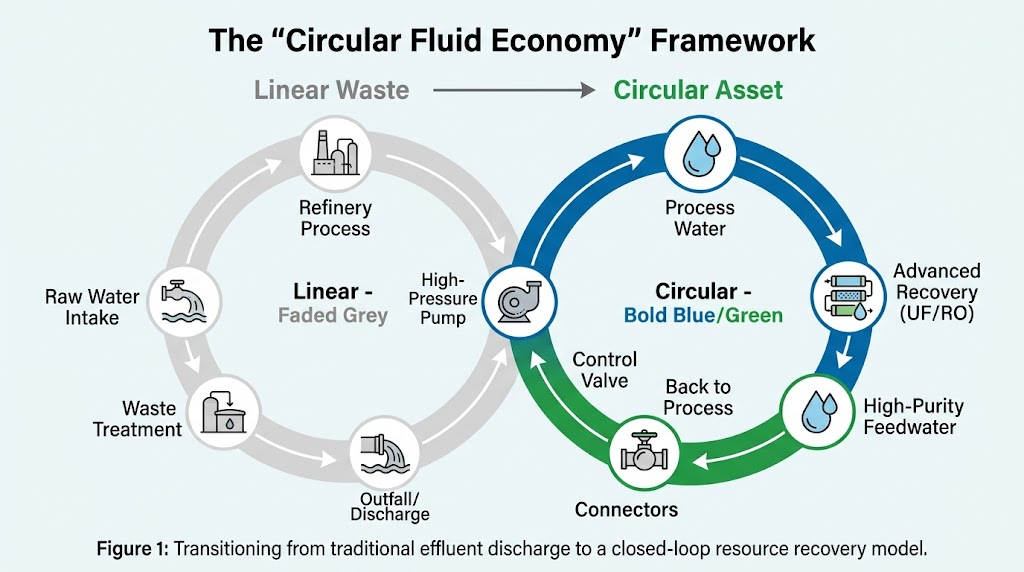
The Circular Fluid Economy framework diagram comparing linear wastewater discharge with a closed-loop UF and RO recovery model.
The Circular Fluid Economy Framework — Transitioning industrial refinery effluent from traditional discharge to an advanced closed-loop water recovery system using UF/RO technologies.

The traditional “treat and discharge” model is becoming obsolete. Instead, the “Refinery of the Future” views every stream as a source of recoverable value. These streams include produced water from upstream operations, sour water from the vacuum distillation unit, and cooling blowdown. By optimizing the fluid loop, refineries can reduce their “raw water” footprint. They can also minimize the energy required for thermal processes. At the same time, they can lower the risk of equipment failure caused by corrosion or scaling.

This is not merely an environmental goal. It is also a financial imperative. In regions where water scarcity is a geopolitical reality, the ability to recycle 90% or more of process water can determine a refinery’s long-term viability.

High-Performance Pumping: The Mechanical Heart of the Fluid Loop

In the heavy industrial environment of a refinery or gas processing plant, pumping system performance plays a critical role in operational uptime. Meanwhile, the industry is moving toward more complex fluid recovery and Minimal Liquid Discharge (MLD) systems. As a result, the technical demands on pumps continue to increase.

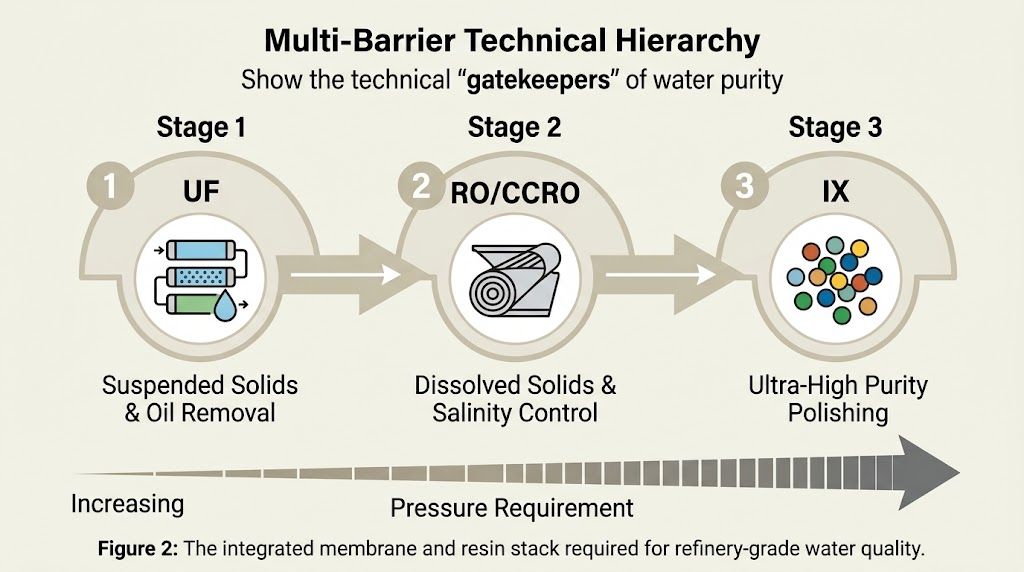
Diagram showing 3-stage water purification: UF filtration, RO/CCRO membrane, and IX resin polishing.
Multi-Barrier Technical Hierarchy illustrating the three-stage filtration process (UF, RO/CCRO, and IX) required to achieve refinery-grade water purity under increasing pressure requirements.

1. Navigating Extreme Pressures and Abrasive Media

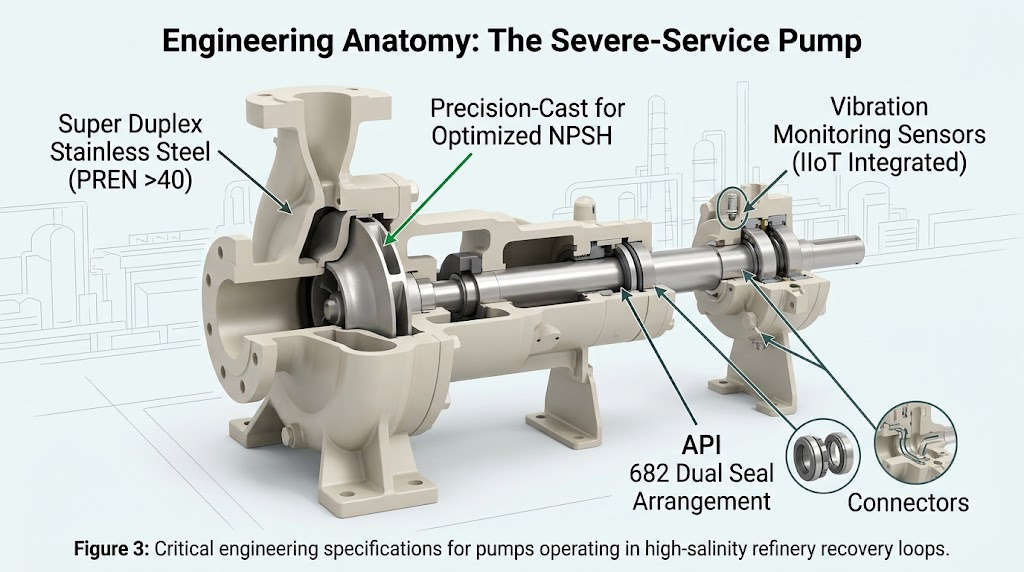
Advanced water recovery systems, such as High-Pressure Reverse Osmosis (HPRO) or Brine Concentration units, require pumps that can maintain consistent flow at pressures exceeding 80 bar. In these applications, standard centrifugal pumps are insufficient. Therefore, engineers increasingly specify API 610 compliant multi-stage pumps made from Super Duplex stainless steel or nickel-based alloys. These materials help the pumps withstand the corrosive nature of concentrated brine and chemical effluents.

2. Efficiency and the NPSH Challenge

The Net Positive Suction Head (NPSH) requirements in refinery water loops are notoriously difficult to manage. This challenge becomes more serious with hot process water or fluids with high vapor pressure. To address it, modern pumping solutions integrate sophisticated impeller designs and Variable Frequency Drives (VFDs). These technologies help prevent cavitation, which can destroy a pump’s internal components within weeks.

In addition, better hydraulic efficiency can reduce total electricity consumption by 15-20%. Therefore, pump optimization can have a direct impact on the plant’s bottom line.

3. Mechanical Seals and Leakage Prevention

In the Oil & Gas sector, the impact of a leak goes beyond fluid loss. It can also create serious safety and regulatory risks. API 682 dual-seal systems help contain process fluids even if the primary seal fails.

For overseas specialists, the seal support system deserves the same attention as the pump itself. Selecting the right system is essential when designing resilient fluid management infrastructure.

Precision Valve Technology: The Gatekeepers of Process Integrity

If pumps are the heart of the refinery, valves are the nervous system. Their role has also changed. In advanced fluid management and resource recovery, valves now do more than simple “on/off” control. They provide high-precision process control.

Cross-section diagram of a severe-service pump showing mechanical seals, impeller, and sensors.
Engineering anatomy of a severe-service industrial pump, detailing critical design features and specifications required for high-salinity refinery recovery loops.

1. Severe Service Control Valves

Process water recovery often involves “dirty” streams. These streams can contain catalyst fines, sand, or corrosive salts. Under such conditions, standard valves can quickly suffer from erosion.

As a result, the industry is moving toward Severe Service Valves with tungsten carbide trims and ceramic linings. These materials help maintain tight shut-off. They also prevent “wire-drawing” and internal leakage that could compromise the purity of recovered water.

2. Fugitive Emissions and Environmental Compliance

Refineries face intense pressure to reduce fugitive emissions. These emissions often come from unintended leaks around valve stems and seals. Therefore, overseas operators are increasingly adopting “Low-E” (Low Emission) certified valves.

These components use advanced packing materials, such as graphite-based composites. They also use live-loaded gland systems. Together, these technologies help keep VOCs (Volatile Organic Compounds) and hazardous gases within the process loop.

In a “Water Refinery,” this level of containment is vital. It helps keep wastewater treatment units safe for personnel and the surrounding environment.

3. Digital Actuation and Real-Time Monitoring

The integration of IIoT (Industrial Internet of Things) into valve actuation has transformed maintenance. Smart actuators can monitor valve torque profiles in real-time. If a valve requires more torque to close than usual, the system can signal a potential build-up of scale or debris.

For a refinery’s water recovery unit, this predictive capability enables earlier intervention. Maintenance teams can schedule service before a failure leads to a plant-wide shutdown.

Beyond Water: The Role of Separation and Filtration in Hydrocarbon Recovery

While much of the discussion focuses on water, the same “Water Refinery” technologies also apply to hydrocarbon recovery. Advanced membrane separation can recover valuable solvents from waste streams. It can also separate oil-water emulsions that were previously considered “un-treatable.”

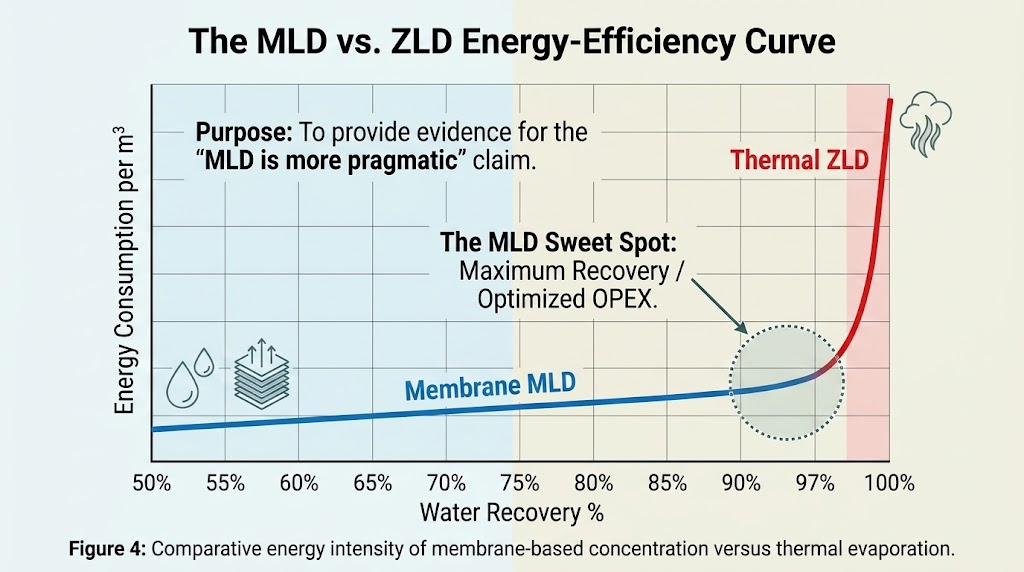
Energy efficiency graph comparing Minimal Liquid Discharge (MLD) and thermal Zero Liquid Discharge (ZLD).
Comparative energy intensity of membrane-based concentration (MLD) versus thermal evaporation (ZLD), demonstrating the cost-efficiency sweet spot before thermal energy demands surge.

1. Ultrafiltration (UF) as a Protective Shield

In the pre-treatment stages of refinery effluent, Ultrafiltration membranes provide a robust barrier against suspended solids and emulsified oils. By removing these contaminants, UF protects downstream high-pressure pumps and Reverse Osmosis (RO) membranes from fouling.

This stage is critical for refineries looking to upgrade their “Sour Water Strippers” or “Desalter Effluent” systems. In these systems, hydrocarbons can quickly degrade traditional treatment equipment.

2. Selective Ion Exchange for Catalyst Protection

Ion exchange (IX) technology is no longer limited to water softening. In modern petrochemical processing, specialized resins remove trace metals and impurities from liquid hydrocarbon streams. This process helps prevent the poisoning of expensive catalysts in hydrocracking or reforming units.

Moreover, high-precision dosing pumps can work together with IX columns. This synergy shows how fluid machinery and chemical engineering can work together to improve refinery profitability.

Achieving Minimal Liquid Discharge (MLD): The New Operational Standard

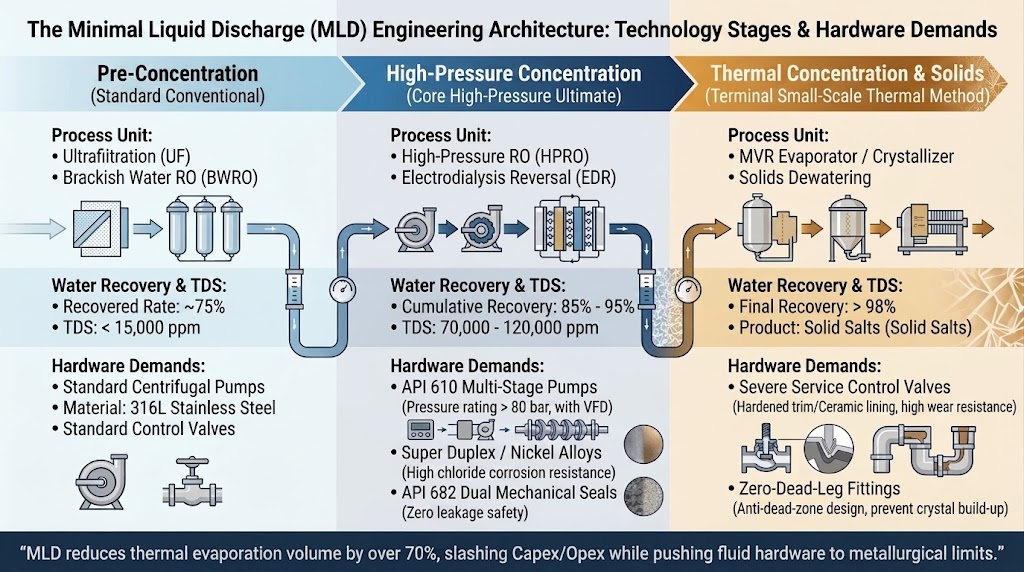
Diagram showing Minimal Liquid Discharge (MLD) engineering architecture across three process stages and hardware demands.
Process stages and technical hardware requirements for a 3-stage Minimal Liquid Discharge (MLD) engineering architecture, showing water recovery rates and TDS concentrations.

The ultimate technical challenge in the Oil & Gas fluid loop is the transition from “treatment” to “zero or minimal liquid discharge.” Traditional Zero Liquid Discharge (ZLD) systems rely heavily on thermal evaporators. These systems are notoriously energy-intensive and prone to severe scaling.

The “Water Refinery” model instead advocates for an MLD approach. This approach uses a sequence of advanced membrane processes to concentrate brine to its highest possible saturation point before thermal intervention begins.

However, this process places immense stress on fluid hardware. Each component must handle increasingly demanding conditions.

Pumps, Valves, and Pipe Fittings

  • Pumps must handle fluid densities and viscosities that change as concentration increases.
  • Valves must operate in high-salinity environments, where the risk of chloride stress corrosion cracking (CSCC) is extreme.
  • Pipe Fittings must use “zero-dead-leg” designs to prevent the accumulation of solids.

By mastering MLD, a refinery can recover up to 98% of its process water. At the same time, it can significantly reduce the volume of waste that must be hauled away or evaporated.

For the overseas specialist, this represents the pinnacle of fluid engineering. It creates a system where mechanical and chemical precision can virtually eliminate waste.

The Economic Case for Fluid Innovation

The primary barrier to upgrading fluid systems in the Oil & Gas sector is often perceived as Capex (Capital Expenditure). However, a deeper analysis of “Total Cost of Ownership” (TCO) reveals a different story.

When a refinery invests in high-efficiency pumps, low-leakage valves, and advanced filtration, it can create several long-term benefits.

1. Energy Costs Drop

Modern hydraulic designs and VFD integration reduce the power required to move fluids.

2. Maintenance Cycles Extend

The right metallurgy and smart monitoring can reduce the frequency of “unplanned” outages.

3. Chemical Consumption Decreases

Precision dosing and better pre-treatment mean fewer chemicals are needed for boiler water or cooling tower maintenance.

4. Resource Recovery

Recovered water and minerals can directly offset the cost of raw material procurement.

In the competitive global market, refineries that fail to optimize their fluid loops will find themselves at a structural disadvantage. By contrast, operators that embrace the “Water Refinery” philosophy can build a more efficient and resilient operation.
Leading the Global Conversation on Fluid Technology

The evolution of the Oil & Gas industry is being written in the flow of its fluids. From the upstream produced water to the downstream petrochemical effluent, the ability to move, control, and refine these streams is the key to future-proofing the energy sector.

As a leading platform for the global pump and valve industry, FLOWTECH CHINA recognizes that the challenges faced by overseas specialists—be they in the North Sea, the Middle East, or the Gulf of Mexico—are universal. The need for reliable, efficient, and intelligent fluid machinery has never been greater.

The “Water Refinery” is more than just a technological trend; it is a blueprint for a more resilient and sustainable Oil & Gas industry. By focusing on the mechanical integrity of pumps, the precision of valves, and the innovation of filtration membranes, FLOWTECH CHINA can transform fluid management from a cost center into a powerful driver of operational excellence.

Leave a Comment

Your email address will not be published. Required fields are marked *

Scroll to Top