Table of Contents
In the modern industrial landscape, especially in global mining, rotating equipment reliability is more than a maintenance metric. It is the heartbeat of the entire value chain. When a critical 90kW or 160kW motor fails at a remote mine site in Western Australia, the Atacama Desert, or the African Copperbelt, the pressure on the operations manager is immense. Every hour of downtime can mean tens of thousands of dollars in lost production. It can also create a major logistical challenge when heavy equipment must travel across vast distances.
Historically, the default response to motor failure has been simple: send the unit to a local workshop for a rewind. For years, operators viewed this as the faster, cheaper, and more sustainable option. However, that logic is now changing. Three forces are driving this shift: higher motor efficiency standards such as IE4 and IE5, the global push for ESG (Environmental, Social, and Governance) compliance, and the growing use of Industry 4.0 “Smart” technologies.
For mining procurement heads and operations managers, the choice is no longer a simple repair-bill-versus-purchase-order comparison. Instead, it requires a broader calculation of Total Cost of Ownership (TCO) and long-term operational resilience. Therefore, mining enterprises must look beyond the immediate fix and evaluate the entire lifecycle of their fluid machinery.
The Physics of Failure and the Technical Compromise of Rewinding
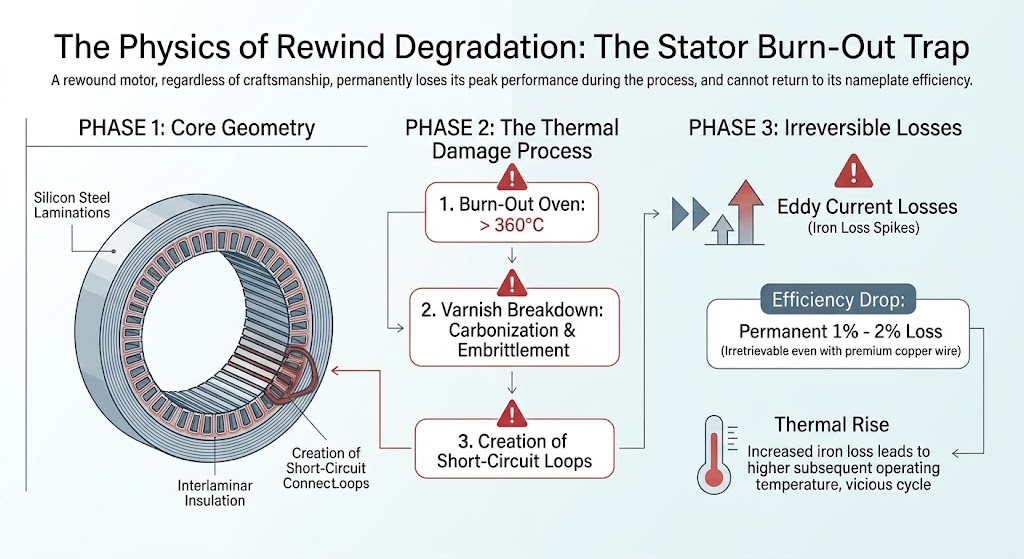
To understand why replacement is increasingly favored over rewinding, it is important to examine the repair process itself. A motor is a precision-engineered device where electromagnetic balance is critical. When a motor fails and requires a rewind, technicians must first remove the old copper windings. This typically involves a “burn-out” process. The stator is heated in an oven to degrade the resin and insulation. Technicians can then strip away the old coils.
The main danger lies in the temperature. If technicians do not strictly control the burn-out oven, the interlaminar insulation between the stator’s silicon steel sheets can suffer irreparable damage. The temperature should ideally remain below 360°C (680°F). Once this insulation suffers damage, the motor experiences higher “eddy current” losses.
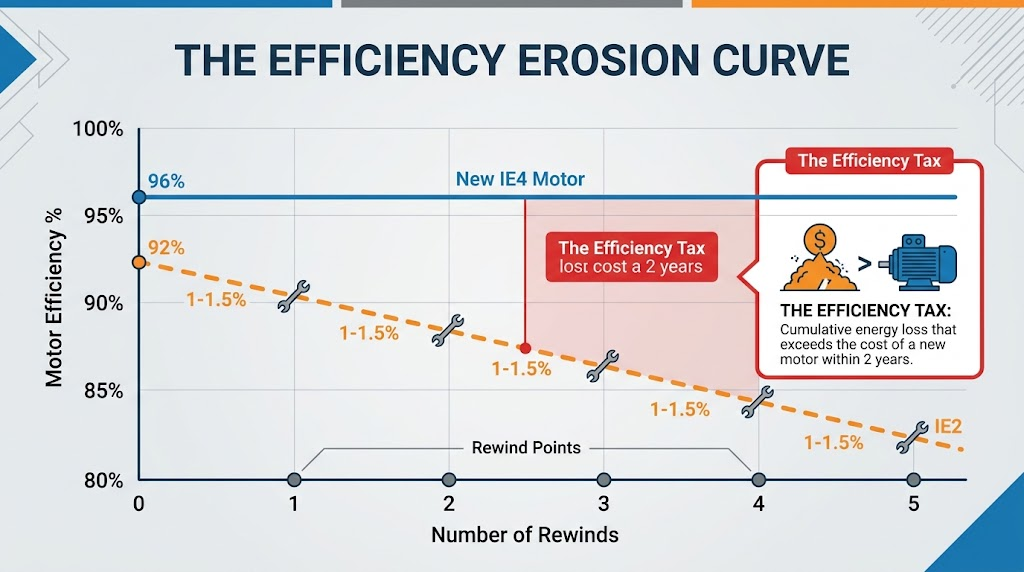
More importantly, a damaged core prevents the motor from returning to its original nameplate efficiency. This remains true even when technicians use high-quality copper and follow a professional rewinding process. Even a high-quality rewind in a certified workshop can result in a 1% to 2% drop in efficiency. This creates a “hidden penalty” that accumulates every second the motor operates.
The IE4 and IE5 Revolution and the Widening Efficiency Gap
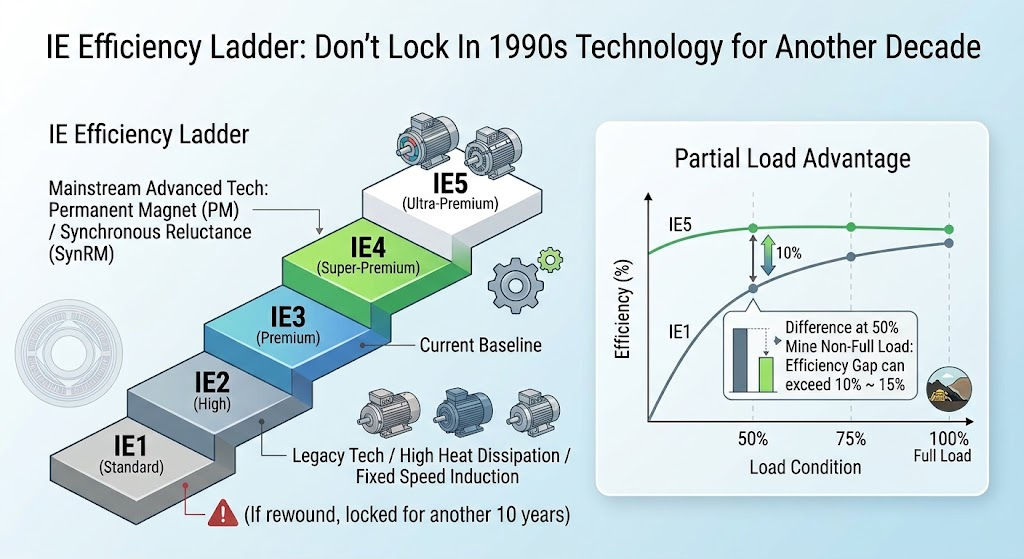
The global motor market is currently undergoing a generational shift. Older mining operations are often populated with “standard efficiency” (IE1) or “high efficiency” (IE2) motors that have been in service for decades. Meanwhile, the latest manufacturing standards from major industrial hubs have moved toward Super-Premium Efficiency (IE4) and Ultra-Premium Efficiency (IE5).
If a 15-year-old IE1 motor is rewound, operators are essentially “locking in” 1990s technology for another decade. By contrast, replacing that unit with a modern IE4 Permanent Magnet (PM) motor or a Synchronous Reluctance (SynRM) motor can deliver a significant efficiency gain. In some partial-load operations, the gain can reach 10% to 15%.
For applications such as slurry pumps or ventilation fans that run 8,000 hours a year, this technology upgrade can significantly reduce electricity consumption. A motor rewind cannot provide the same step change in efficiency.
Total Cost of Ownership as a Management Strategy
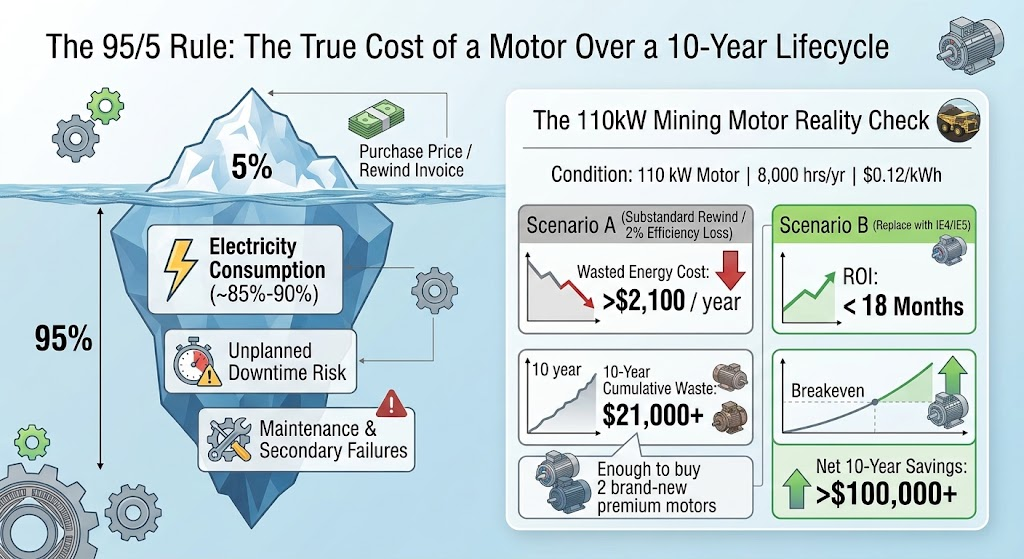
In the mining sector, the purchase price of a motor typically represents less than 5% of its total lifetime cost. Electricity and maintenance account for the remaining 95%. Therefore, making a decision based only on the “repair vs. buy” price gap can be misleading. A repair that saves $3,000 in the short term may create much higher costs over the motor’s lifecycle.
A strategic Total Cost of Ownership (TCO) model considers the “Efficiency Tax.” For example, a 110kW motor operating at $0.12/kWh can waste more than $2,100 in energy each year if a sub-standard rewind causes a 2% efficiency loss. Over ten years, that reaches $21,000. This is more than the cost of two brand-new, high-efficiency motors.
In addition, rewound insulation can have a reduced thermal life. That condition can increase the risk of a secondary failure. As a result, the “cheap” repair can quickly become the more expensive option on the balance sheet.
Thermal Dynamics: How Temperature Dictates Asset Reliability
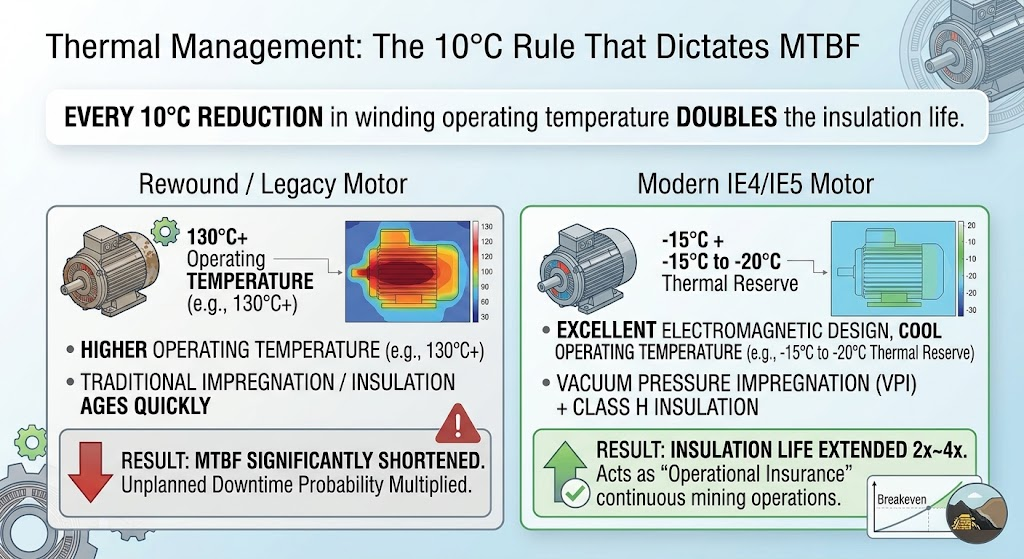
Heat is the primary enemy of electrical equipment. Modern high-efficiency motors are designed to run significantly cooler than their predecessors. In electrical engineering, a common rule of thumb states that every 10°C decrease in operating temperature can effectively double the life of winding insulation.
New motors also use advanced resin-rich vacuum pressure impregnation (VPI) systems and superior Class H insulation. Therefore, when a mining operator chooses a new, high-spec motor instead of a rewind, the benefit goes beyond energy efficiency. The operator also gains a significantly longer Mean Time Between Failures (MTBF).
In an industry where one unplanned stoppage can halt an entire processing plant, this reliability premium becomes an essential form of operational insurance.
Digitalization and the Emergence of the Smart Motor Ecosystem
The mining industry has entered the era of Predictive Maintenance (PdM) and the Industrial Internet of Things (IIoT). Modern motors are no longer simply “dumb” blocks of iron and copper. Instead, they increasingly function as integrated sensors within a digital ecosystem.
Many premium manufacturers exhibiting at international platforms such as FLOWTECH CHINA now offer motors with pre-machined mounting points for vibration sensors. They also provide embedded thermistors that connect directly to cloud-based monitoring platforms.
These “Smart Motors” allow mining engineers to monitor bearing health, winding temperature, and power quality in real time. Engineers can access this information from a central control room thousands of miles away. By comparison, a rewound legacy motor lacks this integrated digital architecture.
While operators can retrofit sensors, these systems may lack the baseline “digital twin” data provided by the manufacturer. As a result, predicting the exact point of failure becomes more difficult.
Decarbonization and the ESG Mandate for Modern Mining
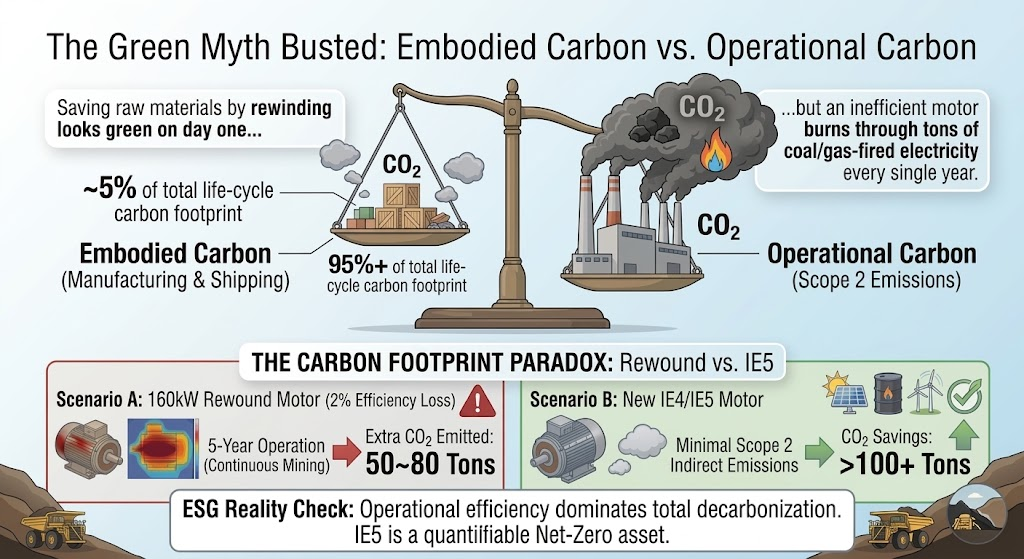
The global mining industry faces intense pressure to reduce its carbon footprint. Major players like Rio Tinto, BHP, and Vale have committed to aggressive “Net Zero” targets. Since electric motors account for approximately 70% of all energy consumed in industrial plants, they represent an important opportunity for carbon reduction.
There is a common misconception that rewinding is always the “greener” choice because it uses less raw steel. However, the carbon intensity of operation can outweigh the carbon intensity of manufacturing.
For example, the CO2 emissions associated with wasted electricity from an inefficient, rewound motor over five years can significantly exceed the emissions from manufacturing and shipping a new, high-efficiency motor. Therefore, upgrading to IE4 or IE5 equipment can provide a measurable way for site managers to support corporate ESG goals.
Global Sourcing Dynamics: The Shrinking Lead-Time Advantage
One historical argument in favor of rewinding was “Lead Time.” In the past, a high-specification motor from a traditional Western OEM could take 20 weeks to reach a remote mine site. By comparison, a local rewind might take only two weeks.
However, this dynamic has changed with the rise of highly efficient manufacturing hubs in Asia. China has streamlined the global supply chain for fluid machinery through its production speed and scale.
Today, high-efficiency motors that meet international standards such as NEMA, IEC, and CSA can be produced and shipped much faster. By leveraging global sourcing hubs, mining companies can also maintain “Critical Spares” inventories of new motors.
As a result, the traditional 14-day rewind does not always offer the same advantage it once did.
A Decision Matrix for High-Stakes Environments
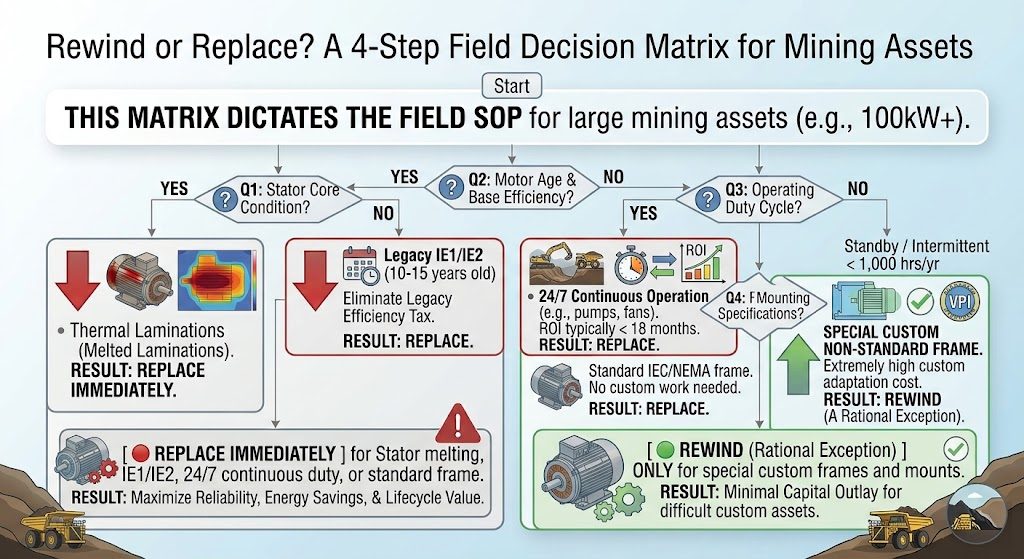
When should a mining operation actually choose to rewind? A structured decision matrix can help professional asset managers make the right choice.
- The Age Factor: If a motor is more than 10-15 years old and dates from the pre-IE3 era, the efficiency gap may be too large to justify a repair. Replacement is the more logical choice.
- The Damage Factor: If the stator core shows signs of damage, or if the motor has suffered a catastrophic “ground to phase” failure that has melted the laminations, rewinding becomes a high-risk option.
- The Duty Cycle: For motors that run 24/7 in critical pumping or cooling applications, the energy savings from a new motor can provide an ROI often in under 18 months.
- The Specialty Exception: Rewinding remains a valid strategy for highly specialized custom-frame legacy motors. A modern replacement may require extensive and costly structural modifications to the existing plant.
Integration with Variable Frequency Drives (VFDs)
A motor failure also creates an opportunity to re-evaluate the efficiency of the entire system. Many centrifugal pumps in mining operate at fixed speeds. They use mechanical valves to throttle flow. This approach can be as inefficient as driving a car with the accelerator fully pressed while using the brakes to control speed.
By replacing a failed motor with a VFD-compatible “Inverter Duty” motor, energy savings can jump from 2% to 40% or more. Modern motors also use reinforced insulation to handle the voltage spikes (dV/dt) associated with high-frequency switching in VFDs.
Older motors may lack this specialized insulation, even after rewinding. When paired with modern drives, they can therefore face a higher risk of premature failure.
Future-Proofing through Technological Exchange
The transition from a “repair-based” culture to a “lifecycle-based” culture requires more than a change in mindset. It also requires access to the latest technological innovations.
As mining operations become more complex, the demands on pump and valve systems continue to increase. Deeper pits and lower-grade ores create even more challenging operating conditions. Therefore, staying ahead of the curve means engaging with global innovators who are defining the next generation of industrial efficiency.
Navigating IE5 motors, smart valve actuators, and high-pressure slurry pumps requires a hands-on approach. Decision-makers need to see the equipment, talk to design engineers, and compare performance data from global suppliers. Industry platforms such as FLOWTECH CHINA provide opportunities to explore these technologies and connect with suppliers across the fluid machinery sector.
Ultimately, mining companies need to evaluate motor rewinding and motor replacement as lifecycle decisions. By considering efficiency, reliability, maintenance, digitalization, and supply chain resilience together, operators can build more cost-effective and future-ready operations.